下载App
资质规则
旅行
账户
Brun066
In fact, this church has come to represent the identity of San Quirico d'Orcia.
Collegiata di San Quirico的点评
点评:The most classic shot of the parish church of San Quirico is the one capturing it from the side facing the main road, also allowing a glimpse of the apse. The beautiful façade is thus ignored, nevertheless the evocative power of this image clearly prevails: I remember seeing this shot of the parish church even before seeing the church in person. It has been written that this shot has ultimately come to symbolize the essence of San Quirico d'Orcia, as well as the town's role as a stop on the Via Francigena.
The building appears valuable as an example — of high stylistic value — of Romanesque-Gothic art. Specifically, the richly ornamented portal of the façade is in pure Romanesque style, as is obvious given its date (1080), while the two side portals are attributable to the 13th-century Gothic style. Overall, the three portals enliven the structure in such a way that it can be considered a masterpiece of "minor" medieval architecture.
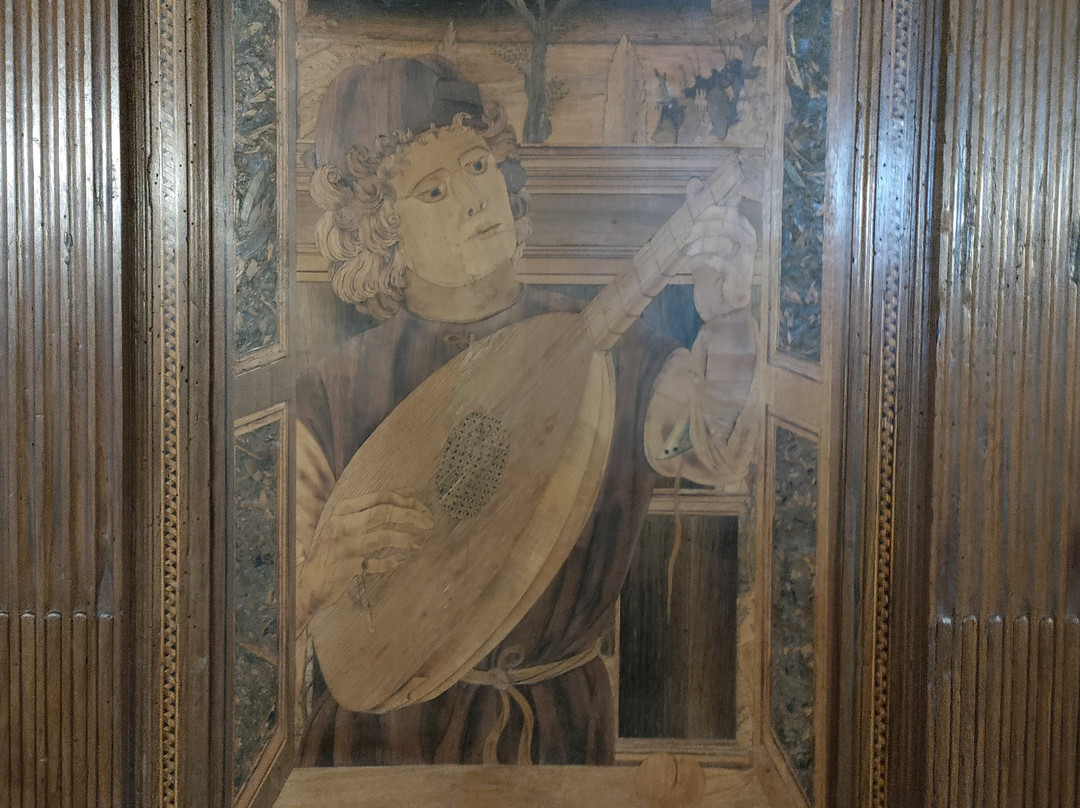
The interior appears less valuable from a stylistic standpoint, having been transformed in the Baroque period, then stripped of these additions. However, two masterpieces are noteworthy: in the left transept, the Madonna and Child Enthroned with Four Saints, by the Sienese artist Sano di Pietro (c. 1470); in the apse, the wooden choir by Antonio Barili (also Sienese, c. 1500), originally in the Siena Cathedral, of which seven of the original 19 beautifully inlaid panels have arrived at San Quirico (most have been lost).
The building appears valuable as an example — of high stylistic value — of Romanesque-Gothic art. Specifically, the richly ornamented portal of the façade is in pure Romanesque style, as is obvious given its date (1080), while the two side portals are attributable to the 13th-century Gothic style. Overall, the three portals enliven the structure in such a way that it can be considered a masterpiece of "minor" medieval architecture.
The interior appears less valuable from a stylistic standpoint, having been transformed in the Baroque period, then stripped of these additions. However, two masterpieces are noteworthy: in the left transept, the Madonna and Child Enthroned with Four Saints, by the Sienese artist Sano di Pietro (c. 1470); in the apse, the wooden choir by Antonio Barili (also Sienese, c. 1500), originally in the Siena Cathedral, of which seven of the original 19 beautifully inlaid panels have arrived at San Quirico (most have been lost).
翻译:圣奎里科教区教堂最经典的镜头是从面向主路的侧面拍摄的,这样也能瞥见教堂的后殿。虽然美丽的正面被忽略了,但这张照片的感染力却丝毫不减:我记得甚至在亲眼见到教堂之前,就已经看过这张照片了。有人写道,这张照片最终成为了圣奎里科·多尔恰的象征,也象征着这座小镇作为弗朗西吉纳古道上一个驿站的地位。
这座建筑作为罗马式-哥特式艺术的典范,具有很高的风格价值。具体来说,正面装饰华丽的入口是纯粹的罗马式风格,这一点从其建造年代(1080年)即可看出;而两侧的入口则属于13世纪的哥特式风格。总而言之,这三个入口赋予了这座建筑勃勃生机,使其成为中世纪“小型”建筑的杰作。
从风格角度来看,教堂内部的价值似乎有所降低,因为它在巴洛克时期曾进行过改造,之后又被移除了这些新增部分。然而,其中有两件杰作值得一提:左侧耳堂内是锡耶纳艺术家萨诺·迪·彼得罗(约1470年)创作的《圣母子与四圣徒宝座像》;后殿内是安东尼奥·巴里利(同样来自锡耶纳,约1500年)创作的木制唱诗班席位,原先位于锡耶纳大教堂,其原有的19块精美镶嵌板中,已有7块被运至圣奎里科教堂(其余大部分已遗失)。
这座建筑作为罗马式-哥特式艺术的典范,具有很高的风格价值。具体来说,正面装饰华丽的入口是纯粹的罗马式风格,这一点从其建造年代(1080年)即可看出;而两侧的入口则属于13世纪的哥特式风格。总而言之,这三个入口赋予了这座建筑勃勃生机,使其成为中世纪“小型”建筑的杰作。
从风格角度来看,教堂内部的价值似乎有所降低,因为它在巴洛克时期曾进行过改造,之后又被移除了这些新增部分。然而,其中有两件杰作值得一提:左侧耳堂内是锡耶纳艺术家萨诺·迪·彼得罗(约1470年)创作的《圣母子与四圣徒宝座像》;后殿内是安东尼奥·巴里利(同样来自锡耶纳,约1500年)创作的木制唱诗班席位,原先位于锡耶纳大教堂,其原有的19块精美镶嵌板中,已有7块被运至圣奎里科教堂(其余大部分已遗失)。

© 2026 Tripadvisor 版权所有。
部分照片由 VFM Leonardo 提供。
TripAdvisor公司对外部网站的内容一概不负责。优惠价格中不含税和其他费用。
ICP证:沪B2-20200433
沪ICP备20013175号
 沪公网安备31010502005427号
鹰程信息技术(上海)有限公司