下载App
资质规则
旅行
账户

Brun066
A location of great scenic beauty, that also boasts a rare geological feature.
Scoglio dell'Ulivo的点评
点评:Situated on the Tyrrhenian coast — in the area where the Aspromonte massif gives way to the low-lying Gioia Tauro plain as one heads north — the territory of Palmi enjoys an exceptional landscape. This is best exemplified by Mount Sant’Elia; while not particularly tall (582 meters), it's highly prominent, rising directly from sea level.
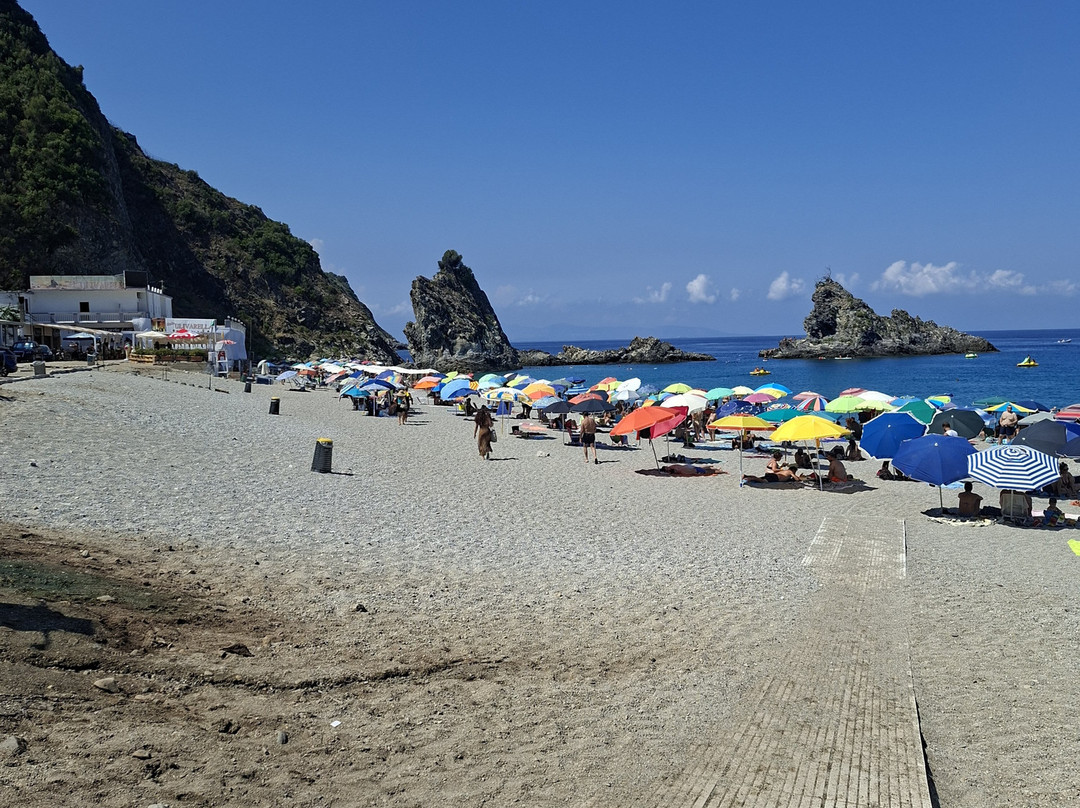
The coastline itself is high and steep, plunging almost straight into the water for the most part; however, near the "Scoglio dell’Ulivo" (Olive Tree Rock), there is a sizable beach of fine gravel that is excellent for swimming. The view is further enhanced not only by the "Scoglio dell’Ulivo", but also by two similar rocky outcrops; arranged in a line with the first, they create a stunning scenic backdrop.
It is easy to understand, then, why the area is packed with beachgoers during the summer: the very season when we visited.
Yet, the site possesses a unique feature that visitors would likely overlook without doing some background reading: its rocky outcrops are a geological rarity.
Having some basic knowledge of geomorphology, I noticed immediately while swimming around them that these rocks were metamorphic in nature; meaning they had undergone structural changes from their original state due to exposure to unusual temperatures and pressures.
What I could not have known — and only discovered through later research — is that they consist of a very rare type of metamorphic rock belonging to the "mylonite" family. These rocks originate from major faults between different rock layers and appear virtually “ground down” (from the Greek "mylos", meaning mill) by the friction generated along those faults. They typically form at depths of 4 km or more, making their emergence at the surface — as seen at Palmi — an exceptional occurrence. Consequently, due to their geological rarity, they are classified as a “geosite” by ISPRA (the Italian Institute for Environmental Protection and Research).
翻译:帕尔米地处第勒尼安海沿岸——也就是从北面望去,阿斯普罗蒙特山脉逐渐过渡为地势低平的乔亚陶罗平原的区域——这里拥有极为优美的自然景观。其中最具代表性的便是圣埃利亚山:虽然海拔并不算高(582米),但它极为醒目,直接从海平面处拔地而起。
这里的海岸线高耸且陡峭,大部分地段几乎垂直没入海中;不过,在“橄榄树岩”附近则有所不同。那里有一片面积不小的细砾石海滩,非常适合游泳。不仅有“橄榄石礁”为景色增色,还有两块类似的岩石突起物;它们与第一块岩石排成一条直线,共同构成了极为壮美的自然背景。
因此,不难理解为何夏季时这片区域会挤满游客——而我们造访的时节恰好就是夏季。这个景点有一个独特之处,如果游客不事先做些了解的话很可能会忽略掉:那里的岩石群在地质学上极为罕见。
由于具备一些地貌学方面的知识,我在游泳时立刻察觉到这些岩石属于变质岩——也就是说,它们因受到异常的温度与压力作用而发生了结构上的变化。我原本不可能知道——直到后来通过研究才发现——这些岩石其实是一种极为罕见的变质岩,属于“糜棱岩”家族。这类岩石形成于不同岩层之间的大型断层带上,由于断层运动产生的摩擦力作用,它们几乎被“磨碎”了(“mylonite”一词源自希腊语“mylos”,意为碾磨)。它们通常在地下4公里乃至更深的的地方形成,因此像在帕尔米这样出现在地表的情况实属罕见。因此,鉴于其地质上的稀有性,它们被ISPRA(意大利环境保护与研究机构)列为“地质遗址”。

© 2026 Tripadvisor 版权所有。
部分照片由 VFM Leonardo 提供。
TripAdvisor公司对外部网站的内容一概不负责。优惠价格中不含税和其他费用。
ICP证:沪B2-20200433
沪ICP备20013175号
 沪公网安备31010502005427号
鹰程信息技术(上海)有限公司